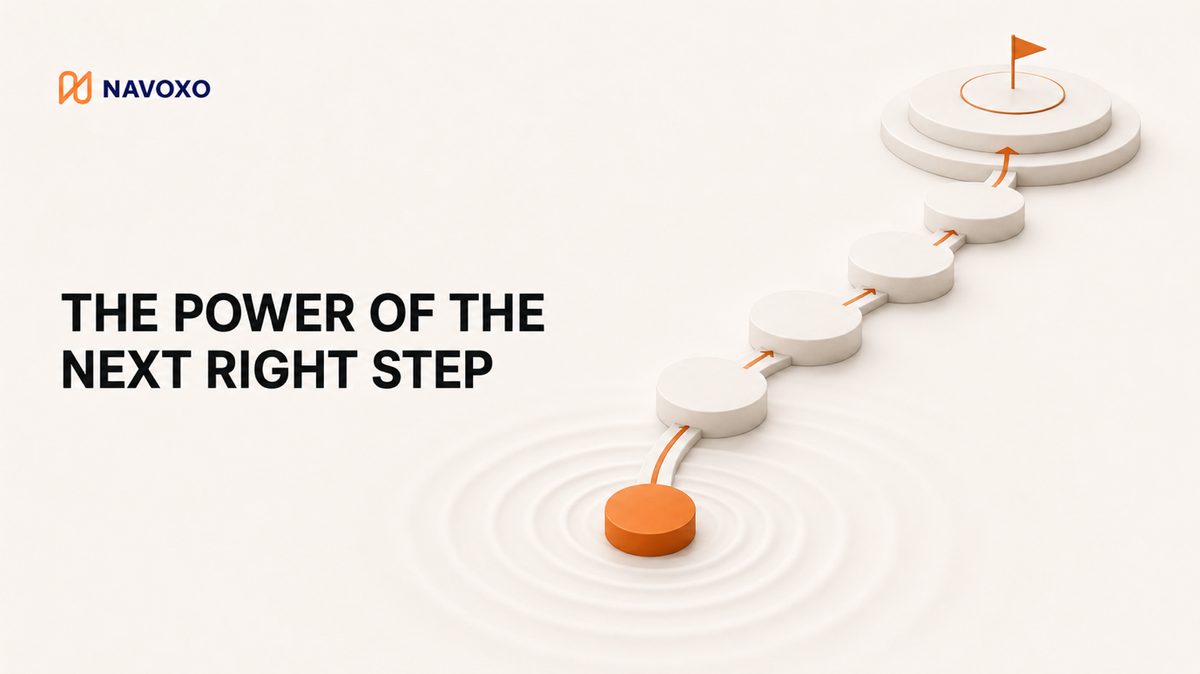
Large goals can be inspiring.
Building a business, changing careers, learning a valuable skill, becoming more confident, or transforming your life can give you a strong sense of purpose.
But large goals can also feel overwhelming.
The distance between where you are and where you want to be may appear so great that you do not know where to begin. You start building detailed plans, comparing different paths, and imagining everything that could go wrong.
Eventually, the goal becomes bigger in your mind while your progress remains unchanged.
The problem is not always a lack of ambition or motivation.
Sometimes, you simply need the next right step.
You do not need the entire journey today
When people feel uncertain, they often try to solve their entire future at once.
Someone considering a career change may try to select the perfect industry, identify every skill they will need, calculate future earnings, choose a course, build a portfolio, and plan their resignation—all before taking the first action.
Someone who wants to start a business may spend months planning the product, brand, website, marketing strategy, pricing, and long-term growth before speaking with a single potential customer.
This creates unnecessary pressure.
You do not need to understand the complete journey before you begin. You only need enough direction to take one meaningful step.
The next right step reduces a distant goal into something you can act on now.
Why overthinking makes action difficult
Overthinking often begins with the desire to make a good decision.
We want to consider every option, understand every risk, and avoid wasting time. But when every possibility receives equal attention, decision-making becomes harder.
We start asking:
- What if I choose the wrong path?
- What if another option is better?
- What if I am not ready?
- What if my plan fails?
- What if I regret this decision later?
These questions may sound responsible, but they can keep us trapped in imagined futures.
The next right step changes the question.
Instead of asking:
How do I guarantee the perfect outcome?
Ask:
What action would help me make a better decision?
This shifts the focus from prediction to learning.
The next step must be personalised
Not every useful action is useful for every person.
Generic advice might tell everyone to quit their job, start posting online, learn to code, or build a business. But the right next step depends on the individual's situation.
It should consider:
- Their current goal
- Their existing skills
- Their available time
- Their financial situation
- Their responsibilities
- Their previous attempts
- Their confidence and readiness
- The biggest obstacle stopping progress
Two people may share the same goal but require completely different first steps.
For someone with limited knowledge, the next step may be learning the basics.
For someone who already understands the subject, another course may become a form of delay. Their next step may be completing a project or offering their skill to a real client.
Personalisation is not simply changing the wording of advice.
It means identifying the action that makes the most sense for that person now.
A small step can create meaningful evidence
A next step does not need to be dramatic to be valuable.
A small action can answer questions that months of thinking cannot.
For example:
- Completing one small project can reveal whether you enjoy a skill.
- Speaking with three potential customers can test whether a problem is real.
- Applying for one suitable opportunity can expose gaps in your preparation.
- Recording a two-minute video can show what needs improvement in your communication.
- Shadowing someone for a day can help you understand a profession more realistically.
- Publishing one piece of work can reveal how people respond to your idea.
Each action produces evidence.
That evidence can confirm your direction, challenge your assumptions, or show you what needs to change.
Even when the result is not what you expected, the step has created learning—and learning is progress.
Action creates confidence
Many people wait to feel confident before they begin.
But confidence rarely arrives through thinking alone. It develops when we act, handle uncertainty, and prove to ourselves that we can move forward.
One completed step makes the next step feel more achievable.
You begin to replace questions with experience:
"I don't know whether I can do this" becomes "I completed the first part."
"I'm afraid I will fail" becomes "I tried, learned something, and can improve."
"I have no idea where to begin" becomes "I know what needs to happen next."
Confidence grows through evidence, not reassurance alone.
Small steps create momentum
Momentum begins when action becomes easier to continue than to avoid.
The first step is usually the most difficult because it must overcome uncertainty, fear, and mental resistance. Once that step is completed, the situation changes.
You have more information. You understand the challenge better. You may have a visible result, useful feedback, or a new opportunity.
The next action is no longer based entirely on imagination.
It is based on what you learned.
This creates a continuous cycle:
Direction → Action → Progress → Reflection → Better Direction
Momentum does not require moving quickly.
It requires continuing to move meaningfully.
The next right step is not always the easiest
The right step should be manageable, but it may still feel uncomfortable.
Sometimes, the next step is having a conversation you have avoided. Sometimes, it is testing an idea before it feels perfect. Sometimes, it is rejecting an attractive opportunity that does not align with your priorities.
A step is not "right" because it feels safe.
It is right because it moves you towards greater clarity, useful evidence, or meaningful progress.
The objective is not to remain comfortable.
It is to avoid becoming overwhelmed while still moving forward.
How to identify your next right step
When you feel stuck, ask yourself these four questions:
1. What outcome matters most right now?
Choose one priority. Trying to advance every goal at once will divide your attention.
2. What is actually preventing progress?
Identify the real obstacle. Is it missing knowledge, insufficient experience, fear, limited resources, or too many options?
3. What action would create the most useful evidence?
Choose a step that helps you learn something real, not simply consume more information.
4. Can I complete it within a clear timeframe?
A useful next step should be specific enough to begin and small enough to finish.
Instead of "learn marketing," choose "complete one beginner marketing project this week."
Instead of "start a business," choose "speak with three potential users before Sunday."
Instead of "become confident," choose "share one idea during tomorrow's meeting."
Specific actions make progress visible.
Progress begins before certainty
You may never feel completely ready.
You may not know whether your chosen direction will remain correct forever. You may need to adjust the plan as you learn.
That is normal.
The purpose of the next right step is not to guarantee the future. It is to move you into a position where the future becomes easier to understand.
One thoughtful action can reduce confusion.
One completed step can strengthen confidence.
One small result can create momentum.
And enough meaningful steps, repeated consistently, can transform a distant goal into a real outcome.
You do not need to solve everything today.
You only need to identify the next right step—and take it.
Stop Overthinking. Get Your Next Step.
Navoxo is being built to help people transform confusion into clarity, direction, and meaningful action.
Stop overthinking. Get your next step.
Navoxo turns confusion into one clear, personalised action.
Get your direction free