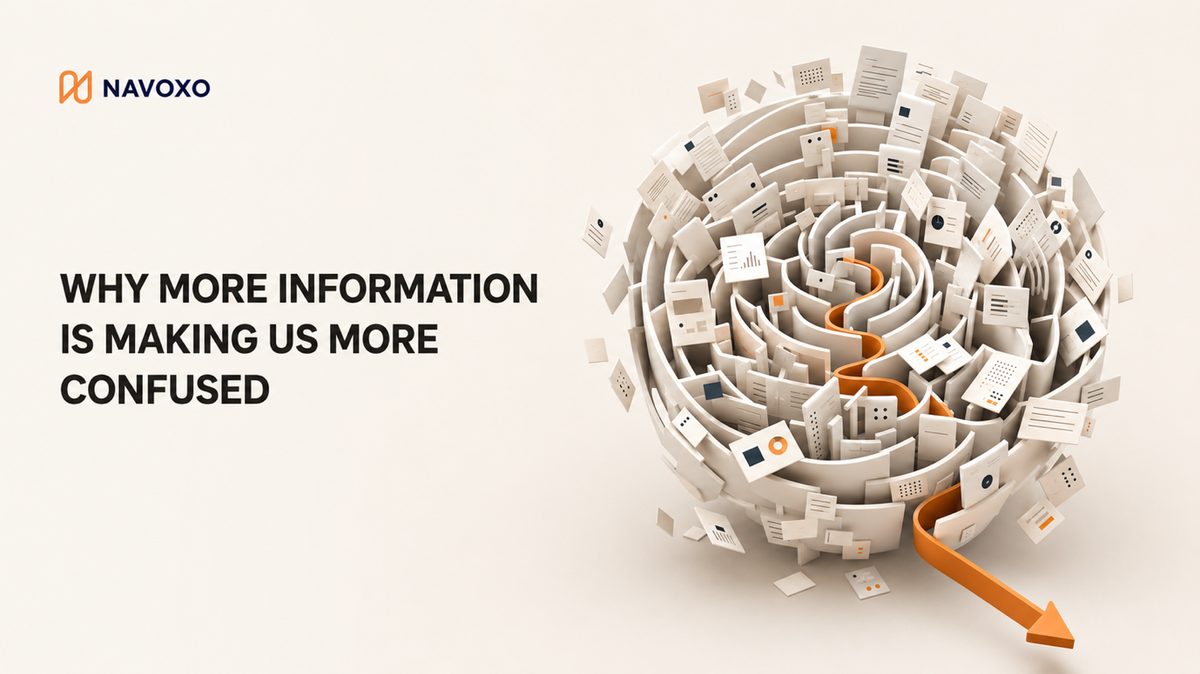
We live in the most informed age in history.
Almost any question can be answered within seconds. Search engines give us millions of results. Social media exposes us to countless perspectives. Podcasts, newsletters, videos, books, and courses can teach us almost anything. AI can explain complex ideas, compare options, create plans, and generate recommendations instantly.
We have more knowledge within reach than any generation before us.
So why do so many of us still feel confused?
Why does choosing a career feel overwhelming? Why do we spend weeks comparing courses without selecting one? Why do we save advice, consult more people, open more tabs, and ask multiple AI tools—yet still struggle to take the first step?
The answer is uncomfortable but important:
More information does not automatically create more clarity. Sometimes, it creates the opposite.
The information problem has changed
For most of history, useful information was difficult to access. Knowledge lived in libraries, universities, institutions, and the minds of a limited number of experts.
If you wanted to understand a profession or learn a new skill, finding trustworthy guidance could take considerable time and effort.
Today, access is rarely the main obstacle.
If you want to change careers, you can find thousands of roadmaps. If you want to start a business, hundreds of creators will tell you how. If you want to learn a skill, there are more courses available than you could complete in a lifetime.
The old question was:
Where can I find the answer?
The new question is:
Which answer actually matters for me?
That is a completely different problem. It is not a problem of access. It is a problem of interpretation, prioritization, and direction.
Every answer creates another possibility
Information expands what we can see. That can be valuable, but every new possibility also creates another decision.
Imagine that you want to learn a valuable digital skill.
One person recommends performance marketing. Another suggests data analytics. A third insists that AI automation is the future. You then discover product design, copywriting, no-code development, cybersecurity, and several other possibilities.
You started with one question:
What should I learn?
Now you have ten possible paths and a new set of questions:
- Which field has the best future?
- Which one matches my strengths?
- Which course should I choose?
- What if the market changes?
- What if I make the wrong decision?
- Should I research a little more before choosing?
More information has not removed uncertainty. It has multiplied it.
This is how possibility quietly becomes pressure. When every path appears potentially valuable, choosing one can feel like losing all the others.
We confuse collecting advice with making progress
Research feels productive.
Watching another video feels like movement. Saving another post feels responsible. Comparing one more course feels safer than committing to the wrong one. Asking another AI system can feel like we are getting closer to certainty.
But consuming information and making progress are not the same thing.
Progress changes our position. It produces a decision, an experiment, a completed action, or a lesson from the real world. Information only creates the possibility of progress.
This distinction matters because research can become a comfortable form of delay. We remain busy without becoming committed. We continue preparing for a decision that may only become clearer after we start acting.
The result is a recurring loop:
Uncertainty → Research → More options → More uncertainty → More research
This loop can continue for weeks, months, or even years—not because we are lazy or incapable, but because we are waiting for information to provide something it cannot provide:
Complete certainty.
Endless opinions make every choice feel questionable
The internet does not simply provide information. It also provides competing interpretations of that information.
For every person recommending one path, another person warns against it.
One creator says everyone should learn to code. Another says AI will reduce the need for programmers. One expert recommends specializing deeply. Another argues that generalists will dominate the future. One entrepreneur promotes leaving your job and taking risks. Another advises building quietly while maintaining financial stability.
Each opinion may be reasonable within a particular situation.
But when we consume them without context, they begin to cancel one another out.
Instead of helping us decide, they make every decision appear incomplete or dangerous. No matter which path we choose, we can find someone explaining why it is the wrong one.
The problem is not that these opinions exist. The problem is expecting them to make a personal decision on our behalf.
Generic advice ignores personal context
Most online advice is created to reach many people. Your decision belongs to one person: you.
An option that works well for someone else may be unsuitable for your goals, responsibilities, finances, experience, available time, or willingness to take risks.
Two people can ask the same question and need entirely different answers.
"Should I leave my job?" cannot be answered thoughtfully without understanding why the person wants to leave, what alternatives they have, how much financial security they possess, what responsibilities they carry, and what they want to do next.
"Which skill should I learn?" depends on existing abilities, interests, market opportunities, resources, and the kind of work the person wants to pursue.
More generic advice cannot solve a context-specific decision.
It often makes the decision harder because every recommendation sounds reasonable within the circumstances of the person giving it. Without filtering that advice through your own reality, you are left comparing answers that were never designed for you.
AI can generate answers—but not automatic clarity
AI has made information dramatically easier to access, organize, and understand. It can compare alternatives, explain unfamiliar subjects, create learning plans, and help us think through difficult questions.
But the ability to generate an answer is not the same as the ability to create direction.
If the question is too broad, the answer may also remain broad. If the system does not understand your circumstances, it may provide intelligent but generic suggestions. If you ask five AI tools the same question, you may receive five convincing but different recommendations.
This can create a new form of overthinking.
We continue rewriting the prompt, requesting another comparison, adding more detail, and generating another roadmap. Each response sounds useful, yet none of them necessarily tells us which step deserves our attention now.
AI becomes most useful when it helps us narrow possibilities, examine our context, and move towards a decision—not when it simply generates more options.
The quality of an answer matters. But whether that answer improves the user's decision matters more.
The fear of making the wrong decision keeps us searching
Beneath endless research, there is often a deeper fear:
What if I choose incorrectly?
When a decision feels important, we naturally want to reduce risk. We imagine that enough research will eventually reveal the perfect option—the choice with maximum benefit, minimum uncertainty, and no possibility of regret.
But most meaningful decisions do not arrive with that level of proof.
Careers evolve. Markets change. Interests develop. New opportunities appear after we begin moving. Some knowledge only becomes available through experience.
Clarity, therefore, is not always something we find before taking action.
Often, it is something we build through action.
A small real-world experiment can teach us more than another week of comparison. Completing a beginner project may reveal whether we enjoy a skill. Speaking with someone already working in a field may challenge our assumptions. Offering a service to one potential client may teach us what the market values.
Action produces evidence that research alone cannot.
Information gives possibilities; direction creates movement
Information is still valuable. The solution is not to stop learning or start making careless decisions. It is to recognize what information can and cannot do.
Information can help us understand our options.
Direction helps us decide which option deserves our attention now.
Information asks:
What could I do?
Direction asks:
Given who I am, where I am, and what I want to achieve, what should I do next?
This shift narrows the problem.
Instead of trying to design an entire future, we identify the next meaningful decision. Instead of comparing every possible path, we focus on the options that fit our current goals and constraints. Instead of waiting for certainty, we choose an action that creates useful evidence.
Direction does not mean knowing everything.
It means knowing enough to move thoughtfully.
A simple way to escape information overload
When you notice yourself collecting more advice without becoming clearer, pause and work through these four questions.
1. What decision am I actually trying to make?
Write it as one clear sentence.
"I need career advice" is too broad.
"I need to decide which skill to test during the next 30 days" is specific and actionable.
2. What personal constraints must the answer respect?
Consider your available time, money, responsibilities, current skills, energy, location, and willingness to take risks.
Constraints are not weaknesses. They help eliminate options that do not fit your present reality.
3. What information would genuinely change my decision?
Separate essential evidence from merely interesting content.
If watching one more video or reading another opinion is unlikely to change your decision, it is probably no longer research. It has become delay.
4. What is the smallest action that would teach me something real?
Choose an experiment.
Complete a small project. Speak with someone working in the field. Take one introductory lesson. Test an offer. Spend one focused week exploring a path instead of endlessly comparing it with others.
The purpose is not to solve your entire life in one step.
It is to replace imagined possibilities with real evidence.
Clarity often comes from subtraction
We usually respond to confusion by adding something:
Another opinion. Another tool. Another plan. Another possibility.
But clarity often comes from removing what does not matter.
It comes from rejecting options that do not fit our present priorities. It comes from accepting that not every good opportunity is the right opportunity. It comes from deciding what we will not pursue—at least for now.
The ability to focus is not a limitation.
It is what turns possibility into progress.
You do not need to understand every available path. You need to identify one path worth testing.
You do not need a perfect plan for your entire life.
You need a meaningful next step.
The question the information age has not answered
The world has built extraordinary systems for delivering information.
We can search faster, learn faster, compare faster, and generate ideas faster than ever before.
But access to answers has not removed the human need for direction.
The challenge is no longer simply finding information. It is understanding ourselves well enough to decide what matters, filtering out what does not, and transforming insight into action.
When you feel overwhelmed by too many answers, do not immediately search for another one.
Pause and ask:
What decision am I actually trying to make—and what is the next step that would help me make it better?
That question may give you something more valuable than additional information.
It may give you direction.
Stop Overthinking. Get Your Next Step.
Navoxo is being built to help people move from confusion to clarity, direction, and meaningful action.
Stop overthinking. Get your next step.
Navoxo turns confusion into one clear, personalised action.
Get your direction free