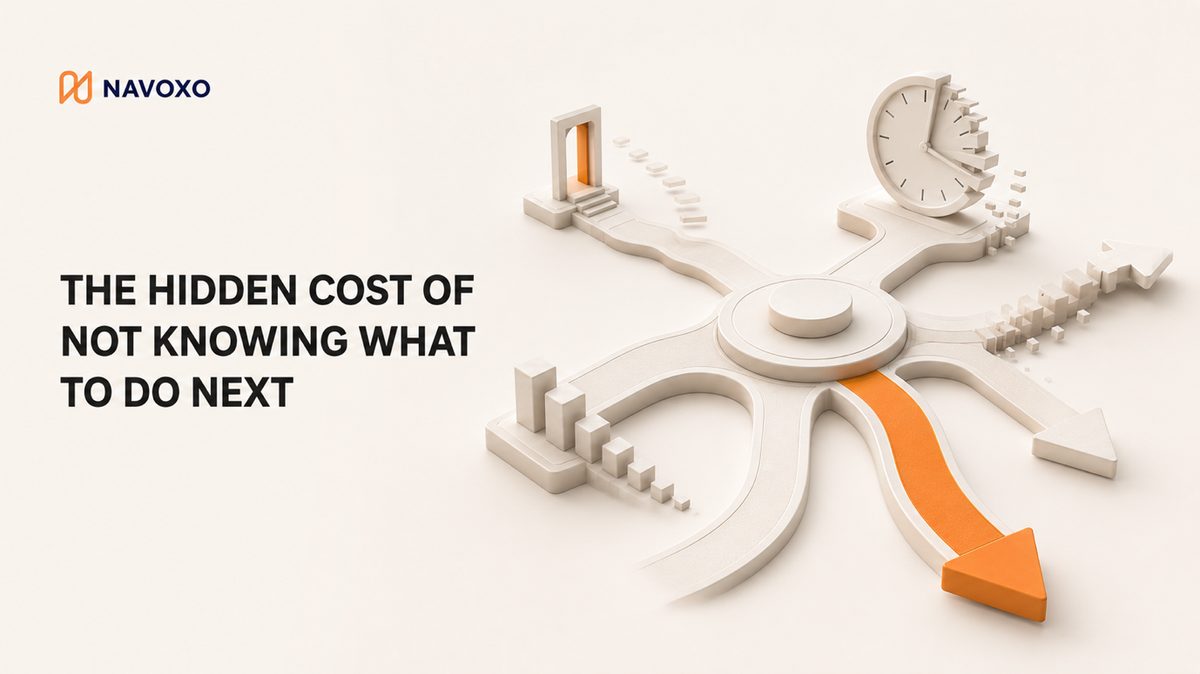
Not knowing what to do next can feel harmless.
You may believe you are simply waiting for more clarity, better timing, or stronger confidence before making a decision. But while you wait, time continues moving—and indecision begins creating consequences of its own.
A delayed decision does not always feel like a loss. There is no immediate failure, rejection, or visible mistake. Yet beneath the surface, uncertainty can quietly take away time, confidence, opportunities, and progress.
Indecision costs more than we realise
Imagine someone who wants to change careers but cannot decide which field to enter.
They spend months comparing industries, watching videos, saving courses, and asking people for advice. Because they are afraid of choosing incorrectly, they never test any option properly.
One year later, they still have the same question—but now they also have one less year to build experience in the field they might have chosen.
The cost was not only the career opportunity.
It was also the time, energy, and confidence lost while waiting.
Time passes even when we do not choose
We often behave as if delaying a decision will preserve all our options. In reality, some options change or disappear with time.
A student postpones learning an important skill. A professional remains in a role that no longer helps them grow. An aspiring founder keeps improving an idea but never tests it. Someone avoids an important conversation until the relationship becomes more difficult to repair.
Weeks become months, and months become years.
The cost of indecision compounds quietly. Unlike money, lost time cannot be recovered.
Confidence decreases without action
Many people wait until they feel confident before taking the next step.
But confidence usually does not arrive before action. It develops after we act, learn, adjust, and survive small uncertainties.
When we repeatedly avoid decisions, we begin to doubt our ability to make them. Every delay becomes evidence that we may not be ready, capable, or brave enough.
Eventually, even small choices start feeling difficult.
The solution is not to make reckless decisions. It is to make manageable ones that allow us to build trust in our own judgment.
Opportunities do not always wait
Not every opportunity has an obvious deadline.
A job opening closes. A market becomes more competitive. A useful connection fades. Someone else acts on an idea. Our personal circumstances change.
This does not mean we should accept every opportunity immediately. Most opportunities are distractions if they do not align with our priorities.
But we must be able to distinguish thoughtful patience from fear-based delay.
Patience is intentional. It has a reason, a timeline, and a plan.
Indecision simply keeps us waiting.
Waiting for certainty creates more uncertainty
We often believe that more thinking will eventually produce a risk-free answer.
But important decisions rarely come with complete certainty.
You cannot know exactly how a new career will feel before experiencing the work. You cannot guarantee that a business idea will succeed before testing it. You cannot fully understand a skill before trying to learn it.
Some clarity can only be discovered through movement.
A small experiment may teach you more than months of research. Completing one project, speaking with someone experienced, testing an idea, or taking a short course can replace imagined fears with real evidence.
You do not always think your way into clarity.
Sometimes, you act your way into it.
The goal is not to decide your entire future
People often remain stuck because they believe the next decision must determine the rest of their lives.
It does not.
Most decisions can be treated as steps rather than permanent commitments. You can test a direction, observe the results, and adjust based on what you learn.
Instead of asking:
What is the perfect decision for my future?
Ask:
What is the smallest meaningful step I can take now?
That step might be completing a small project, researching three carefully selected options, speaking with one expert, submitting one application, or testing an idea with one potential customer.
A useful next step does not need to solve everything.
It only needs to create progress or better information.
Direction protects your future
The greatest danger is not always making the wrong choice.
Sometimes, it is spending so long avoiding the wrong choice that you never make a meaningful one.
Every delayed decision has a cost. It may not be visible today, but it can appear later as lost time, reduced confidence, missed opportunities, and unrealised potential.
You do not need complete certainty to move.
You need enough clarity to take one thoughtful step—and the willingness to learn from what happens next.
Because progress does not begin when every doubt disappears.
It begins when you decide that staying stuck is no longer free.
Stop Overthinking. Get Your Next Step.
Navoxo is being built to help people move from confusion to clarity, direction, and meaningful action.
Stop overthinking. Get your next step.
Navoxo turns confusion into one clear, personalised action.
Get your direction free