Clarity is often treated as the final answer.
We believe that once we understand why we feel stuck, what we want, or what needs to change, everything else will naturally fall into place.
Sometimes it does.
But often, clarity gives us a better understanding of the problem without showing us what to do next.
You may clearly understand that your current job no longer suits you. You may recognise that you need to develop new skills. You may know that you want to build a business, improve your confidence, or change an important part of your life.
Yet one question can remain unanswered:
What should I do next?
That is the difference between clarity and direction.
Clarity helps you understand
Clarity removes confusion from your thinking.
It helps you recognise your goals, challenges, priorities, strengths, and constraints. It allows you to describe your situation more accurately.
For example:
- "I am not unhappy with work itself; I am unhappy because I am no longer learning."
- "I do not lack ambition; I have too many goals competing for my attention."
- "I do not need another course yet; I need experience applying what I already know."
- "I am not afraid of starting—I am afraid of choosing the wrong path."
These realisations are valuable. When we understand the actual problem, we stop wasting energy trying to solve the wrong one.
But understanding alone does not create movement.
Someone can spend months becoming more self-aware while remaining in exactly the same position.
Direction helps you move
Direction takes what you understand and converts it into a decision.
It answers questions such as:
- Which goal deserves my attention first?
- Which option best fits my current situation?
- What should I stop doing?
- What is the next meaningful action?
- How will I know whether I am moving in the right direction?
Clarity might tell you that you need a career change.
Direction identifies one field worth exploring and the first practical way to test it.
Clarity might reveal that your confidence is low because you avoid difficult situations.
Direction gives you one manageable action that helps you face that pattern.
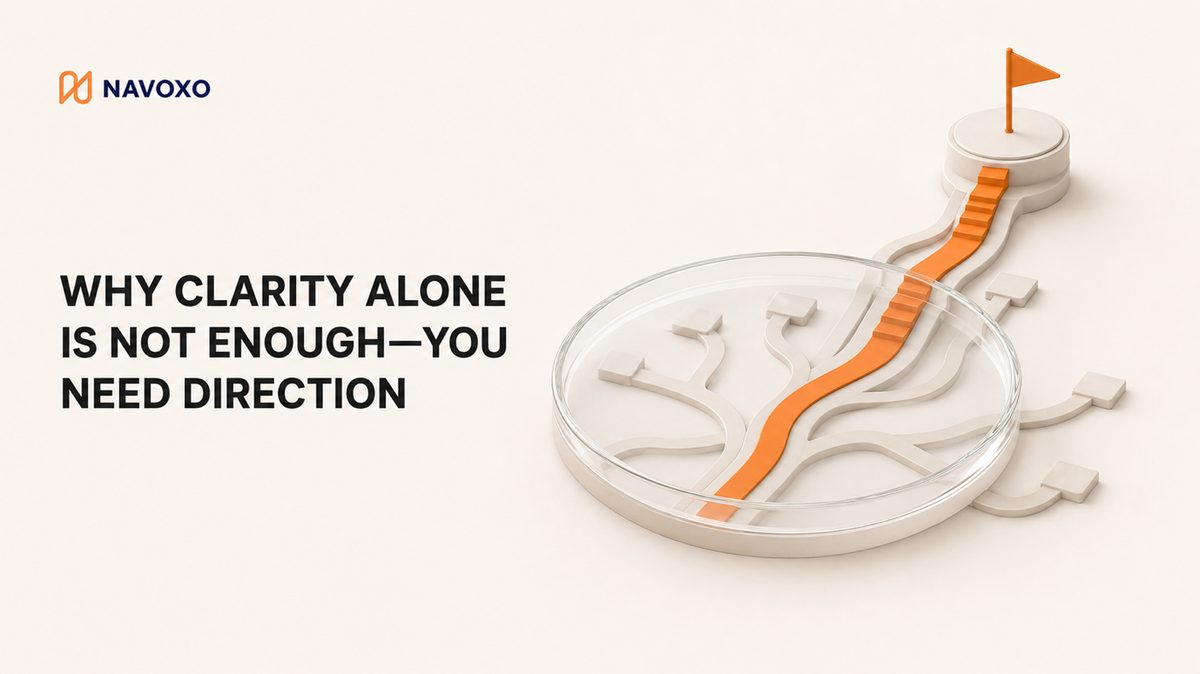
Clarity helps you see the road.
Direction tells you which way to walk.
Why people get stuck after gaining clarity
People do not always remain stuck because they lack understanding. Sometimes, they remain stuck because understanding creates several possible responses.
Suppose you realise that your current career does not match your strengths. That clarity may reveal multiple alternatives: changing roles, learning a new skill, starting freelance work, pursuing higher education, or building a business.
You now understand the problem—but you also have more decisions to make.
Without prioritisation, clarity can create another form of overthinking.
You begin comparing every possible route. You search for the perfect plan. You worry about closing the door on other opportunities. Eventually, you possess a clear understanding of your situation but no commitment to a particular direction.
This is why clarity must lead somewhere.
Direction requires prioritisation
Every meaningful direction involves choosing one thing over another.
That can feel uncomfortable because choosing one path means temporarily rejecting other possibilities. But without that decision, our energy becomes divided across too many goals.
Direction does not mean that only one path could ever work.
It means selecting the path that deserves your attention now based on your goals, circumstances, and available resources.
A useful direction should consider:
- What matters most right now
- What can realistically be done
- What fits your personal situation
- What creates meaningful evidence or progress
- What can be adjusted as you learn
The objective is not to predict your entire future. It is to make the best next decision with the information currently available.
Direction must become action
Direction is incomplete until it produces action.
A roadmap may look intelligent, but it has little value if it leaves you overwhelmed. A useful next step should be specific and manageable enough to begin.
Instead of:
I need to build a new career.
Try:
This week, I will speak with two people working in the field I am considering.
Instead of:
I need to become more confident.
Try:
Today, I will express one opinion that I would normally keep to myself.
Instead of:
I need to start a business.
Try:
I will speak with three potential customers before building the product.
Smaller actions are not less ambitious. They make ambition executable.
Each action also creates new information. You discover what works, what feels right, what needs improvement, and whether your direction should continue or change.
Direction does not remove uncertainty
Having direction does not mean having complete certainty.
You may still feel nervous. You may not know whether your decision will produce the exact result you want. You may need to change your approach later.
Direction simply gives uncertainty a place to go.
Instead of remaining trapped in thought, you move forward thoughtfully. Action creates experience, experience produces learning, and learning improves future decisions.
The process becomes:
Clarity → Direction → Action → Progress → Learning → Better Decisions
Direction is not a permanent command. It should evolve as you gain new information about yourself and the world around you.
From understanding to movement
When you gain clarity about a problem, do not stop there.
Ask yourself:
1. What decision does this understanding require?
2. Which option fits my current goals and constraints?
3. What should I prioritise—and what should I ignore for now?
4. What is the smallest meaningful action I can take next?
These questions transform reflection into movement.
Clarity changes how you see your situation.
Direction changes what you do about it.
Both are essential, but they serve different purposes. Clarity removes the fog. Direction identifies the path. Action begins the journey.
Because understanding where you are is valuable—but progress begins when you decide where to go next.
Stop Overthinking. Get Your Next Step.
Navoxo is being built to help people transform confusion into clarity, direction, and meaningful action.
Stop overthinking. Get your next step.
Navoxo turns confusion into one clear, personalised action.
Get your direction free