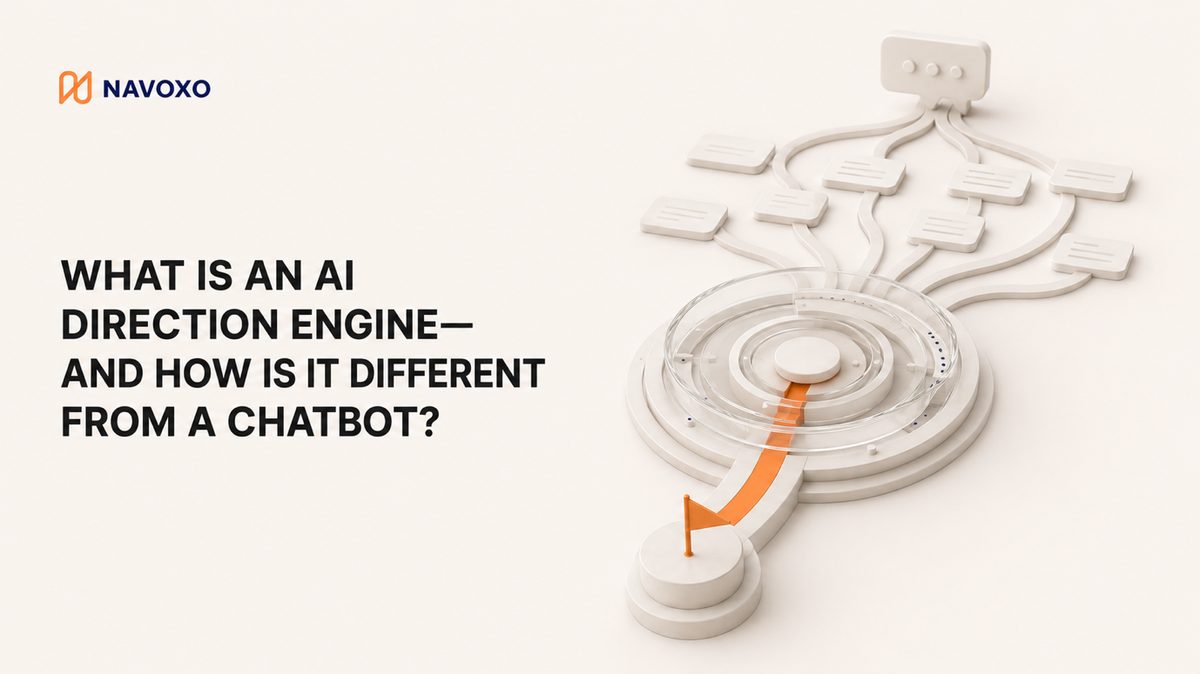
Artificial intelligence has made it possible to receive an answer to almost any question within seconds.
A chatbot can explain a topic, generate ideas, compare options, write a plan, or answer a follow-up question. These abilities are useful, but receiving an intelligent response does not always help someone make a better decision.
A person may ask:
- Which career should I choose?
- Should I leave my current job?
- What skill should I learn next?
- Should I start a business?
- Why am I still feeling stuck?
- What should I do next?
A chatbot can provide several suggestions. But after reading them, the person may still face the same problem: too many possibilities and no clear direction.
That is where an AI Direction Engine is different.
What is an AI Direction Engine?
An AI Direction Engine is a system designed to help someone move from uncertainty to meaningful action.
Its purpose is not simply to answer a question. It aims to understand the person's situation, identify the real decision behind the question, narrow the available options, and recommend a practical next step.
The process can be understood as:
Confusion → Clarity → Direction → Action → Progress
For example, someone may say:
I don't know what to do with my career.
A traditional chatbot might provide a list of suitable industries, popular skills, career assessments, and general advice.
A Direction Engine approaches the question differently. Before recommending anything, it needs to understand:
- What is making the person dissatisfied?
- What abilities and experience do they already have?
- What kind of work do they want?
- How much time and money can they invest?
- What responsibilities or limitations must be considered?
- What have they already tried?
- What outcome matters most right now?
The goal is not to generate the longest or most impressive answer.
The goal is to identify the most useful direction for that individual.
A chatbot focuses on the conversation
Most chatbots are primarily designed around questions and responses.
You enter a prompt. The system generates an answer. You ask another question, and the conversation continues.
The quality of the experience is often measured through factors such as:
- How accurate was the response?
- How quickly was it generated?
- How natural did the conversation feel?
- How many different tasks could the AI perform?
- How much information could it provide?
These things matter. But they do not automatically prove that the conversation improved the user's life.
A response can be intelligent while leaving the user overwhelmed. A detailed plan can be impressive but unrealistic. A long list of possibilities can provide information without producing a decision.
Conversation is the interface.
It should not be the final outcome.
A Direction Engine focuses on transformation
An AI Direction Engine is designed around what changes after the interaction.
Did the user understand their situation more clearly?
Did they identify the real problem?
Were unnecessary options removed?
Did they make a better decision?
Did they take a meaningful action?
Did that action create progress or useful learning?
These questions shift the focus from generating answers to producing outcomes.
The real product is not the conversation itself. It is the movement that happens because of it:
Uncertainty → Understanding → Direction → Action → Progress
Users may not remember every response they received. But they will remember whether the experience helped them move forward.
It narrows options instead of multiplying them
Generative AI is exceptionally good at creating possibilities.
Ask for career ideas, and it can provide twenty. Ask for business opportunities, and it can generate fifty. Ask for a learning plan, and it can create a detailed six-month roadmap.
But people who already feel confused do not always need more possibilities.
They often need help deciding:
- Which option fits their current situation?
- Which opportunity deserves attention now?
- What should be postponed?
- What can be ignored completely?
- What is the smallest meaningful next step?
A Direction Engine does not remove choice from the user. It makes choice more manageable.
Intelligence creates possibilities.
Direction turns possibilities into decisions.
It considers the person, not only the prompt
The same question can require different answers for different people.
Imagine two individuals asking:
Should I leave my job and start a business?
One may have savings, industry experience, a validated idea, and few financial responsibilities. The other may have significant responsibilities, limited savings, and an idea that has not yet been tested.
The question is identical, but the right direction may be completely different.
Useful guidance must consider context.
That includes the person's:
- Goals
- Strengths
- Constraints
- Priorities
- Resources
- Responsibilities
- Previous decisions
- Completed actions
- Changing circumstances
Without this context, AI may produce reasonable advice that is still unsuitable for the person receiving it.
Personalisation should mean more than adjusting the tone of an answer.
It should improve the quality of the decision.
Direction must become an executable next step
Knowing where to go is valuable, but direction alone is incomplete if it never becomes action.
A Direction Engine should convert a broad goal into something the user can realistically begin.
For example:
Instead of:
Build a new career in digital marketing.
It might recommend:
Choose one beginner-level marketing project this week and complete it using a real or fictional brand.
Instead of:
Validate your business idea.
It might recommend:
Speak with three potential users and ask how they currently solve the problem.
Instead of:
Improve your communication skills.
It might recommend:
Record a two-minute explanation of one familiar topic and review it for clarity.
A useful next step should be small enough to begin but meaningful enough to create evidence.
That evidence helps the system and the user decide what should happen next.
It learns through action and reflection
A fixed plan assumes that circumstances will remain unchanged.
Real life rarely works that way.
People discover new strengths. Priorities change. Unexpected obstacles appear. Some actions succeed, while others reveal that the chosen path needs adjustment.
For this reason, direction should be adaptive.
After an action, the system should help the user reflect:
- What happened?
- What worked?
- What felt difficult?
- What did the user learn?
- Does the direction still make sense?
- What should change next?
This creates a continuous cycle:
Direction → Action → Reflection → Learning → Better Direction
The objective is not to control the user's future. It is to strengthen their ability to make better decisions over time.
AI should strengthen judgment, not replace it
An AI Direction Engine should never make people dependent on technology for every choice.
Its role is not to command users or claim that it can predict the perfect future. It should help them understand trade-offs, examine their circumstances, and move forward with greater confidence.
The final decision should remain with the user.
Good direction does not remove human judgment.
It strengthens it.
Over time, the user should become more capable of recognising patterns, prioritising opportunities, and making thoughtful decisions independently.
Why Navoxo is building this category
Navoxo is not being built because the world needs another chatbot.
The world already has extraordinary systems for generating information and answering questions. Yet millions of people still struggle to decide what matters and what they should do next.
Navoxo exists between information and action.
It is being designed as an AI Direction Engine that helps people:
- Understand their real situation
- Identify what matters most
- Reduce unnecessary options
- Choose a meaningful direction
- Turn that direction into action
- Learn from the outcome
- Make better decisions over time
The technology may continue evolving. AI models will become faster and more capable. But the purpose of Navoxo should remain constant.
Users should not remember which AI model powered the experience.
They should remember how their decisions—and eventually their lives—improved because of it.
Stop Overthinking. Get Your Next Step.
Navoxo is being built to transform uncertainty into clarity, direction, and meaningful action.
Stop overthinking. Get your next step.
Navoxo turns confusion into one clear, personalised action.
Get your direction free